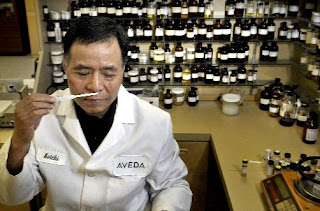
Ko-ichi Shiozawa, chief perfumer at Aveda, smelled a scent sample containing 15 essential oils that will be featured in a new Aveda shampoo and conditioner, available next year. Behind him are samples of hundreds of essential oils.
Chief perfumer Ko-ichi Shiozawa can easily find the fragrances he hopes to use in Aveda's products. It's harvesting the organic oils without the use of petrochemicals that keeps him hard at work.
By DEE DePASS, Star Tribune
Last update: August 17, 2008 - 11:58 AM
For years, "the nose" of Aveda has traveled the Amazon River in Brazil, the flower fields of Corsica and the banks of the Nile in Egypt in search of his aromatic holy grail: a lone, elusive ingredient that just might defy mother nature.
But more often than not these days, Aveda's chief perfumer Ko-ichi Shiozawa has returned from his quests empty-handed. His frustration is apparent in the way he rubs his temples and raps his knuckles to a drumbeat of discontent at his vial-strewn desk.
Plant-based "essential oils are not enough for me anymore. I am obsessed with organic, I must say," said Shiozawa, 67, one of just 400 perfumers nationwide.
His stubborn hunt for an organic plant-based solvent would help Aveda's already fragrant offerings stand out even more in a $170 billion industry that still relies on about 3,000 synthetic chemicals to inexpensively make stable and long-lasting scents.
Founded in Minneapolis 30 years ago and now based in Blaine, Aveda has become a global champion of upscale, all-natural and "pure essence" shampoos, conditioners, skin lotions and other beauty products. The $7.6 billion Estée Lauder cosmetics firm liked the plant-science concept so much that it paid Aveda founder Horst Rechelbacher $300 million for the company 11 years ago.
Since then, Aveda's Minnesota employment has grown from 400 to about 710. Revenue has quintupled, and while company officials declined to disclose it, they are quick to credit Shiozawa and his team with a chunk of the company's success.
"Ko-ichi is the originator of the 'It smells Aveda!' factor," said Dominique Conseil, Aveda's president. A few years ago, he said, he challenged Shiozawa to create more organic essential oils, and Shiozawa came through. Aveda has increased its percentage of certified-organic essential plant oils from 25 percent to more than 90 percent, Conseil said.
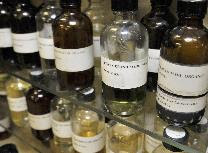
Aveda relies on about 200 essential plant oils and is increasingly demanding that the raw seeds, bark, roots, flowers and leafy ingredients come from organic farms and through organic processes. By mixing a tenth of a milligram of this and a drop of that, Shiozawa has developed thousands of natural and organic aromatic formulas in his organ-shaped lab that is lined with rows and rows of small glass bottles.
But he is far from content. Turns out, extracting the sweet scent of a blessed flower is mighty hard to do without petrochemical solvents.
"Only the rose" truly retains its sweet flowery aroma after distilling without chemicals, Shiozawa said.
Sure, he can get chemical-free "certified organic" ylang-ylang oils from Madagascar's cananga tree flowers, lavender from Bulgaria, and neroli orange blossom from Egypt and Morocco. But they can produce odors that reek of musty earth, musk or mint -- nothing like the sweet floral scents he craves.
"If I can have these new flowery notes, I am pretty sure Aveda's organic perfume would be quite exciting and interesting," Shiozawa said. "Everybody knows there's no such thing as an organic flower note. It would be a breakthrough."
And lucrative, he concedes with a chuckle.
Trained as a chemist, Shiozawa abandoned that career years ago and moved from Japan to Paris, to study French literature at the Sorbonne. He fell in love -- with France, a Frenchwoman who would become his wife, and perfume.
He landed in a perfume training program in the foothills of the French Alps where jasmine, rose, violets, orange flower and rosemary scents "wafted through the streets." He later worked in Switzerland, New Jersey and the not-so-picturesque Long Island City, N.Y., where Shiozawa, a father of four, toiled making pleasant scents for household products.
But all that was before a French friend suggested Shiozawa join him at Aveda. Shiozawa recalled asking him: "Aveda? What is that? ... Minnesota? Where is that?"
That was 18 years ago. Austrian-born Rechelbacher tapped Shiozawa to head Aveda's Botanical Aroma Department after a dinner at D'Amico that lasted for hours. The two discussed essential oils, Shiozawa's passion for German poetry and all things French.
But 18 years later, he's not reading poetry.
Close but elusive
"Grrrr!" growled the normally eloquent Shiozawa recently, after dipping one of his ubiquitous white scent blotter-sticks into a 2-inch vial of organic jasmine.
The smell is burnt and pungent, like cinnamon-spiced meat left on a grill to decay.
"I would go to the ends of the Earth to find" the natural process that could let a flower oil still smell like a flower after distilling," Shiozawa said. "If it's physically feasible, I'd like to find it."
Two jasmine finds, one from Egypt and the other in India, came close.
The Egyptian jasmine extract was ruled not organic by the U.S. Department of Agriculture's National Organics Program a year after Aveda had begun marketing it in salons in a new men's line. Aveda had to scramble to get the product back for relabeling.
"We had to switch to the jasmine treated with the petrochemical solvent," Shiozawa said. Crestfallen, he searched on.
A trip to India in December restored hope. A supplier of supposedly organic jasmine thrust its product under Shiozawa's unforgiving scrutiny. Rigorous farm and lab inspections and ingredient analyses ensued.
The oil, which Shiozawa blotted and sniffed again and again, passed test after test, delivering sweet, flowery jasmine notes. Ah, the holy grail danced within reach.
But this month, sitting crossed-armed at his desk strewn with dozens of scent sticks jammed into tiny bottles of fennel, rosemary, seagrass and other oils, Shiozawa is frowning.
"There's something fishy."
The Indians are not returning his calls.
"I am specializing in such a unique field of organic, organic, organic. It is a most difficult challenge," he said, wearily shaking his head. "This is not fun. Not fun."
To cope, the perfumer with the wrinkle-free face and hands clings to his Renaissance passions. He buries himself in mathematics and Italian language books in his study, plays Bach and Chopin on his piano, romps through YouTube in search of the latest performances by Bobby McFerrin, and takes walks to clear his head from the endless frustration.
That's not to say he's without successes.
Last year, Shiozawa introduced Yatra, Aveda's first all-organic, aroma therapy "Pure-fume," to critics' applause. It emits an intense, fragrant punch that comes from environmentally harvested Bulgarian lavender, soft Australian sandalwood (harvested by Aborigines) and South African geranium rose oils. His organic Rose Attar oil launched in February. And a third organic perfume goes on sale in November, in time for the holidays.
"It is not enough," Shiozawa sighed. "We must treat [more] flowers with something other than water and find this plant-based [organic] solvent. That is the biggest challenge," he said. "I have to come up with something somehow. But it's getting harder and harder."
Complex supply chain
John Bailey, chief scientist of the 600-member Personal Care Products Council, said an organic-ingredient mandate for any company would prove difficult. Naturals can develop more complex scents than synthetics, he said, but they also create what he called "a very complex raw-material supply chain."
"When you are making the conscientious effort to use the organic and natural raw materials obtained from China or India or Australia or South America, then that certainly places on you a responsibility to be able to stand behind that aspect of your product," Bailey said. "I can see where he has lots of frequent-flier miles."
Peter Matravers, vice president of Aveda research and development, said Shiozawa and his nose are up to the challenge.
"He is one of the few perfumers in the world that works with organic essences. And he has an artistry for what I call Zen aroma, where he is able to blend five or six essential oils and make a beautiful bouquet," Matravers said. "Other scientists and other perfumers will have to have 50 or 100 compounds to do the same thing."
Dee DePass • 612-673-7725
http://www.startribune.com/business/27027359.html?page=4&c=y



 As the bubonic plague ravaged Europe in the year 1413, the story of the four thieves arrived on the scene and the story has changed history. They were captured and charged with robbing the dead and dying victims but it was noticed that they remained free of the plague. When the thieves were tried, the magistrate offered leniency if they would reveal how they resisted contracting the infection as they performed their gruesome acts. The four thieves explained that they were perfumers and spice traders and finally exposed their special concoction of aromatic herbs, including cloves and rosemary, that they rubbed on their hands, ears, and temples. This prevented them from contracting the disease! And as a result the “bird-masks” were invented to be worn by doctors as protection against airborne bacteria. In the beak was placed a material infused in a blend of essential oils that would filter, and kill, bacteria. These masks later became the “prototype” for the well-known Venetian carnival-mask.


